
In this recently updated article on Forbes Advisor
(https://www.forbes.com/advisor/) Cathy Haan and Cassie Bottorff provide a useful and detailed 11-step guide to starting your business. The article begins with considering your mindset and moves on to your business concept. You also complete a SWOT analysis (strengths, weaknesses, opportunities, and threats) to consider how the market would react to the introduction of your product or idea.
The business planning process is covered in detail in the article and includes a downloadable business planning template.
Overlooked in most articles about business startups, the authors took the time to bring up the issue of scalability of the business and exit strategy. The article also includes consideration of your marketing and social media strategies, team building, and choosing the right business tools. This article is feature-rich and filled with information and numerous links to useful resources.
Starting a business is one of the most exciting and rewarding experiences you can have. But where do you begin? There are many ways to approach creating a business, with many important considerations. To help take the guesswork out of the process and improve your chances of success, follow our comprehensive guide on how to start a business. We’ll walk you through each step of the process, from defining your business idea to registering, launching, and growing your business.
Before You Begin: Get in the Right Mindset
The public often hears about overnight successes because they make for a great headline. However, it’s rarely that simple—they don’t see the years of dreaming, building, and positioning before a big public launch. For this reason, remember to focus on your business journey and don’t measure your success against someone else’s.
Consistency Is Key
New business owners tend to feed off their motivation initially but get frustrated when that motivation wanes. This is why it’s essential to create habits and follow routines that power you through when motivation goes away.
Take the Next Step
Some business owners dive in headfirst without looking and make things up as they go along. Then, there are business owners who stay stuck in analysis paralysis and never start. Perhaps you’re a mixture of the two—and that’s right where you need to be. The best way to accomplish any business or personal goal is to write out every possible step it takes to achieve the goal. Then, order those steps by what needs to happen first. Some steps may take minutes while others take a long time. The point is to always take the next step.
1. Determine Your Business Concept
Most business advice tells you to monetize what you love, but it misses two other very important elements: it needs to be profitable and something you’re good at. For example, you may love music, but how viable is your business idea if you’re not a great singer or songwriter? Maybe you love making soap and want to open a soap shop in your small town that already has three close by—it won’t be easy to corner the market when you’re creating the same product as other nearby stores.
If you don’t have a firm idea of what your business will entail, ask yourself the following questions:
These questions can lead you to an idea for your business. If you already have an idea, they might help you expand it. Once you have your idea, measure it against whether you’re good at it and if it’s profitable.
Your business idea also doesn’t have to be the next Scrub Daddy or Squatty Potty. Instead, you can take an existing product and improve upon it. Or, you can sell a digital product so there’s little overhead.
What Kind of Business Should You Start?
Before you choose the type of business to start, there are some key things to consider:
Consider Popular Business Ideas
Not sure what business to start? Consider one of these popular business ideas:
2. Research Your Competitors and Market
Most entrepreneurs spend more time on their products than they do getting to know the competition. If you ever apply for outside funding, the potential lender or partner wants to know: what sets you (or your business idea) apart? If market analysis indicates your product or service is saturated in your area, see if you can think of a different approach. Take housekeeping, for example—rather than general cleaning services, you might specialize in homes with pets or focus on garage cleanups.
Primary Research
The first stage of any competition study is primary research, which entails obtaining data directly from potential customers rather than basing your conclusions on past data. You can use questionnaires, surveys, and interviews to learn what consumers want.
Surveying friends and family isn’t recommended unless they’re your target market. People who say they’d buy something and people who do are very different. The last thing you want is to take so much stock in what they say, create the product, and flop when you try to sell it because all of the people who said they’d buy it don’t because the product isn’t something they’d buy.
Secondary Research
Utilize existing sources of information, such as census data, to gather information when you do secondary research. The current data may be studied, compiled, and analyzed in various ways that are appropriate for your needs but it may not be as detailed as primary research.
Conduct a SWOT Analysis
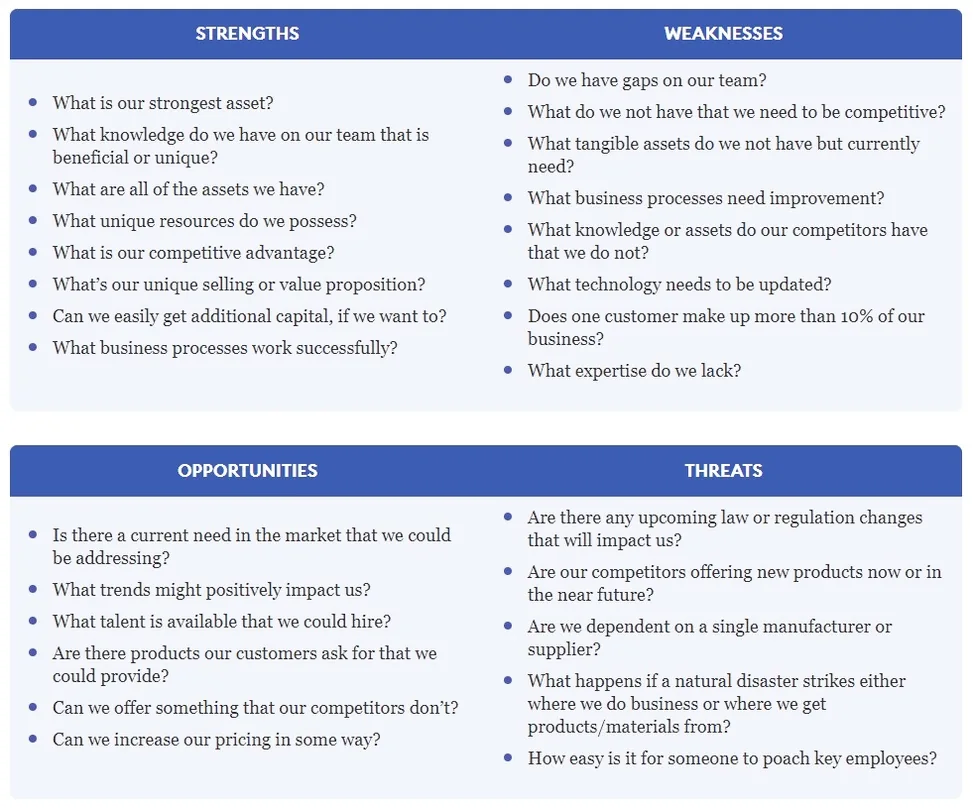
SWOT stands for strengths, weaknesses, opportunities, and threats. Conducting a SWOT analysis allows you to look at the facts about how your product or idea might perform if taken to market, and it can also help you make decisions about the direction of your idea. Your business idea might have some weaknesses that you hadn’t considered or there may be some opportunities to improve on a competitor’s product.
3. Create Your Business Plan
A business plan is a dynamic document that serves as a roadmap for establishing a new business. This document makes it simple for potential investors, financial institutions, and company management to understand and absorb. Even if you intend to self-finance, a business plan can help you flesh out your idea and spot potential problems. When writing a well-rounded business plan, include the following sections:
Learn more: Download our free simple business plan template.
Come Up With an Exit Strategy
An exit strategy is important for any business that is seeking funding because it outlines how you’ll sell the company or transfer ownership if you decide to retire or move on to other projects. An exit strategy also allows you to get the most value out of your business when it’s time to sell. There are a few different options for exiting a business, and the best option for you depends on your goals and circumstances.
The most common exit strategies are:
Develop a Scalable Business Model
As your small business grows, it’s important to have a scalable business model so that you can accommodate additional customers without incurring additional costs. A scalable business model can be replicated easily to serve more customers without a significant increase in expenses.
Some common scalable business models are:
Start Planning for Taxes
One of the most important things to do when starting a small business is to start planning for taxes. Taxes can be complex, and there are several different types of taxes you may be liable for, including income tax, self-employment tax, sales tax, and property tax. Depending on the type of business you’re operating, you may also be required to pay other taxes, such as payroll tax or unemployment tax.
4. Choose Your Business Structure
When structuring your business, it’s essential to consider how each structure impacts the amount of taxes you owe, daily operations, and whether your personal assets are at risk.
LLC
An LLC limits your personal liability for business debts. LLCs can be owned by one or more people or companies and must include a registered agent. These owners are referred to as members.
Pros
Cons
Limited Liability Partnership (LLP)
An LLP is similar to an LLC but is typically used for licensed business professionals such as an attorney or accountant. These arrangements require a partnership agreement.
Pros
Cons
Sole Proprietorship
If you start a solo business, you might consider a sole proprietorship. The company and the owner, for legal and tax purposes, are considered the same. The business owner assumes liability for the business. So, if the business fails, the owner is personally and financially responsible for all business debts.
Pros
Cons
Corporation
A corporation limits your personal liability for business debts just as an LLC does. A corporation can be taxed as a C-corporation (C-corp) or an S-corporation (S-corp). S-corp status offers pass-through taxation to small corporations that meet certain IRS requirements. Larger companies and startups hoping to attract venture capital are usually taxed as C-corps.
Pros
Cons
Before you decide on a business structure, discuss your situation with a small business accountant and possibly an attorney, as each business type has different tax treatments that could affect your bottom line.
Helpful Resources
5. Register Your Business and Get Licenses
There are several legal issues to address when starting a business after choosing the business structure. The following is a good checklist of items to consider when establishing your business:
Choose Your Business Name
Make it memorable but not too difficult. Choose the same domain name, if available, to establish your internet presence. A business name cannot be the same as another registered company in your state, nor can it infringe on another trademark or service mark that is already registered with the United States Patent and Trademark Office (USPTO).
Business Name vs. DBA
There are business names, and then there are fictitious business names known as “Doing Business As” or DBA. You may need to file a DBA if you’re operating under a name that’s different from the legal name of your business. For example, “Mike’s Bike Shop” is doing business as “Mike’s Bikes.” The legal name of the business is “Mike’s Bike Shop,” and “Mike’s Bikes” is the DBA.
You may need to file a DBA with your state, county, or city government offices. The benefits of a DBA include:
Register Your Business and Obtain an EIN
You’ll officially create a corporation, LLC, or other business entity by filing forms with your state’s business agency―usually the Secretary of State. As part of this process, you’ll need to choose a registered agent to accept legal documents on behalf of your business. You’ll also pay a filing fee. The state will send you a certificate that you can use to apply for licenses, a tax identification number (TIN), and business bank accounts.
Next, apply for an employer identification number (EIN). All businesses, other than sole proprietorships with no employees, must have a federal employer identification number. Submit your application to the IRS and you’ll typically receive your number in minutes.
Get Appropriate Licenses and Permits
Legal requirements are determined by your industry and jurisdiction. Most businesses need a mixture of local, state, and federal licenses to operate. Check with your local government office (and even an attorney) for licensing information tailored to your area.
Helpful Resources
6. Get Your Finances in Order
Open a Business Bank Account
Keep your business and personal finances separate. Here’s how to choose a business checking account—and why separate business accounts are essential. When you open a business bank account, you’ll need to provide your business name and your business tax identification number (EIN). This business bank account can be used for your business transactions, such as paying suppliers or invoicing customers. Most times, a bank will require a separate business bank account to issue a business loan or line of credit.
Hire a Bookkeeper or Get Accounting Software
If you sell a product, you need an inventory function in your accounting software to manage and track inventory. The software should have ledger and journal entries and the ability to generate financial statements.
Some software programs double as bookkeeping tools. These often include features such as check writing and managing receivables and payables. You can also use this software to track your income and expenses, generate invoices, run reports, and calculate taxes.
There are many bookkeeping services available that can do all of this for you and more. These services can be accessed online from any computer or mobile device and often include features such as bank reconciliation and invoicing. Check out the best accounting software for small businesses, or see if you want to handle the bookkeeping yourself.
Determine Your Break-Even Point
Before you fund your business, you must get an idea of your startup costs. To determine these, make a list of all the physical supplies you need, estimate the cost of any professional services you will require, determine the price of any licenses or permits required to operate, and calculate the cost of office space or other real estate. Add in the costs of payroll and benefits, if applicable.
Businesses can take years to turn a profit, so it’s better to overestimate the startup costs and have too much money than too little. Many experts recommend having enough cash on hand to cover six months of operating expenses.
When you know how much you need to get started with your business, you need to know the point at which your business makes money. This figure is your break-even point.
Break-even point = Fixed cost ÷ Contribution margin
In contrast, the contribution margin = total sales revenue – cost to make the product
For example, let’s say you’re starting a small business that sells miniature birdhouses for fairy gardens. You have determined that it will cost you $500 in startup costs. Your variable costs are $0.40 per birdhouse produced, and you sell them for $1.50 each.
Let’s write these out so it’s easy to follow:
| Fixed costs: | $500 for the first month |
| Variable costs: | $0.40 per birdhouse |
| Price per birdhouse: | $1.50 |
| The formula: | $500/($1.50 – $0.40) |
| $500 ÷ $1.10 = 456 units | |
This means that you need to sell at least 456 units just to cover your costs. If you can sell more than 456 units in your first month, you will make a profit.
Helpful Resources
7. Fund Your Business
There are many different ways to fund your business—some require considerable effort, while others are easier to obtain. Two categories of funding exist: internal and external.
Internal funding includes:
If you finance the business with your own funds or with credit cards, you have to pay the debt on the credit cards and you’ve lost a chunk of your wealth if the business fails. By allowing your family members or friends to invest in your business, you are risking hard feelings and strained relationships if the company goes under. Business owners who want to minimize these risks may consider external funding.
External funding includes:
Small businesses may have to use a combination of several sources of capital. Consider how much money is needed, how long it will take before the company can repay it, and how risk-tolerant you are. No matter which source you use, plan for profit. It’s far better to take home six figures than make seven figures and only keep $80,000 of it.
Funding ideas include:
Choose the right funding source for your business by considering the amount of money you need, the time frame for repayment, and your risk tolerance.
Helpful Resources
8. Apply for Business Insurance
You need to have insurance for your business, even if it’s a home-based business or you don’t have any employees. The type of insurance you need depends on your business model and what risks you face. You might need more than one type of policy, and you might need additional coverage as your business grows. In most states, workers’ compensation insurance is required by law if you have employees.
Work With an Agent To Get Insured
An insurance agent can help determine what coverages are appropriate for your business and find policies from insurers that offer the best rates. An independent insurance agent represents several different insurers, so they can shop around for the best rates and coverage options.
Basic Types of Business Insurance Coverage
Helpful Resources
9. Get the Right Business Tools
Business tools can help make your life easier and make your business run more smoothly. The right tools can help you save time, automate tasks, and make better decisions.
Consider the following tools in your arsenal:
10. Market Your Business
Many business owners spend so much money creating their products that there isn’t a marketing budget by the time they’ve launched. Alternatively, they’ve spent so much time developing the product that marketing is an afterthought.
Create a Website
Even if you’re a brick-and-mortar business, a web presence is essential. Creating a website doesn’t take long, either—you can have one done in as little as a weekend. You can make a standard informational website or an e-commerce site where you sell products online. If you sell products or services offline, include a page on your site where customers can find your locations and hours. Other pages to add include an “About Us” page, product or service pages, frequently asked questions (FAQs), a blog, and contact information.
Optimize Your Site for SEO
After getting a website or e-commerce store, focus on optimizing it for search engines (SEO). This way, when a potential customer searches for specific keywords for your products, the search engine can point them to your site. SEO is a long-term strategy, so don’t expect a ton of traffic from search engines initially—even if you’re using all the right keywords.
Create Relevant Content
Provide quality digital content on your site that makes it easy for customers to find the correct answers to their questions. Content marketing ideas include videos, customer testimonials, blog posts, and demos. Consider content marketing one of the most critical tasks on your daily to-do list. This is used in conjunction with posting on social media.
Get Listed in Online Directories
Customers use online directories like Yelp, Google My Business, and Facebook to find local businesses. Some city halls and chambers of commerce have business directories too. Include your business in as many relevant directories as possible. You can also create listings for your business on specific directories that focus on your industry.
Develop a Social Media Strategy
Your potential customers are using social media every day—you need to be there too. Post content that’s interesting and relevant to your audience. Use social media to drive traffic back to your website where customers can learn more about what you do and buy your products or services.
You don’t necessarily need to be on every social media platform available. However, you should have a presence on Facebook and Instagram because they offer e-commerce features that allow you to sell directly from your social media accounts. Both of these platforms have free ad training to help you market your business.
Helpful Resources
11. Scale Your Business
To scale your business, you need to grow your customer base and revenue. This can be done by expanding your marketing efforts, improving your product or service, collaborating with other creators, or adding new products or services that complement what you already offer.
Think about ways you can automate or outsource certain tasks so you can focus on scaling the business. For example, if social media marketing is taking up too much of your time, consider using a platform such as Hootsuite to help you manage your accounts more efficiently. You can also consider outsourcing the time-consumer completely.
You can also use technology to automate certain business processes, including accounting, email marketing, and lead generation. Doing this will give you more time to focus on other aspects of your business.
When scaling your business, it’s important to keep an eye on your finances and make sure you’re still profitable. If you’re not making enough money to cover your costs, you need to either reduce your expenses or find ways to increase your revenue.
Build a Team
As your business grows, you’ll need to delegate tasks and put together a team of people who can help you run the day-to-day operations. This might include hiring additional staff, contractors, or freelancers.
Resources for building a team include:
You might also consider partnering with other businesses in your industry. For example, if you’re a wedding planner, you could partner with a florist, photographer, catering company, or venue. This way, you can offer your customers a one-stop shop for all their wedding needs.
Another example is an e-commerce store that partners with a fulfillment center. This type of partnership can help you save money on shipping and storage costs, and it can also help you get your products to your customers faster.
To find potential partnerships, search for businesses in your industry that complement what you do. For example, if you’re a web designer, you could partner with a digital marketing agency.
You can also search for businesses that serve the same target market as you but offer different products or services. For example, if you sell women’s clothing, you could partner with a jewelry store or a hair salon.
Helpful Resources
Bottom Line
Starting a small business takes time, effort, and perseverance. But if you’re willing to put in the work, it can be a great way to achieve your dreams and goals. Be sure to do your research, create a solid business plan, and pivot along the way. Once you’re operational, don’t forget to stay focused and organized so you can continue to grow your business.
Reference
Haan, Kathy and Bottorff, Cassie. “How To Start A Business in 11 Steps (2022 Guide),” Business, 9 Nov. 2022. Forbes,
How To Start A Business In 11 Steps (2022 Guide) – Forbes Advisor.